Your privacy is important to us
We use cookies that are necessary for the processing of statistical and technical analyses for website usage.
By closing the Cooking Banner, by clicking the “X” symbol or by denying consent, you will continue browsing without profiling or marketing cookies.
By consenting to the usage of profiling and marketing cookies, we will be able to provide advertising messages that correspond to your needs.
We use cookies that are necessary for the processing of statistical and technical analyses for website usage.
Necessary
Necessary cookies help make the website usable by enabling basic functions such as page navigation and access to protected areas of the site. The website cannot function properly without these cookies. Farmina
SESSID: Preserves the user's status on the various pages of the website and allows access to restricted areas. expiration: Session Type: HTTP
farmina_lang: Saves the selected language. expiration: 1 year Type: HTTP
cookie_test: Used to check if the user's browser supports cookies. expiration: 60 minutes Type: HTTP
CookieConsent#: Stores the user's cookie consent status for the current domain. expiration: 1 year Type: HTTP
Statistics
Statistical cookies help website owners understand how visitors interact with websites by collecting and transmitting information anonymously. Google
_gid: Registers a unique ID used to generate statistical data on how the visitor uses the website. expiration: 1 day Type: HTTP
_gat_farminaGlobal: Used by Google Analytics to collect data on the number of times a user has visited the website, as well as data for the first visit and the most recent visit. expiration: a few seconds Type: HTTP
_dc_gtm_UA#: Used by Google Analytics to collect data on the number of times a user has visited the website, as well as data for the first visit and the most recent visit. expiration: a few seconds Type: HTTP
Google Tag Manager
_ga: Registers a unique ID used to generate statistical data on how the visitor uses the website. expiration: 2 years Type: HTTP
Marketing
Marketing cookies are used to track website visitors. Their purpose is to show advertisements that are relevant and engaging for the individual user and therefore of greater value for third-party editors and advertisers.
Facebook
_fbp: Store and track visits across websites. expiration: 3 months Type: HTTP
Google
ads/ga-audiences: Used by Google AdWords to re-engage visitors that are likely to convert to customers based on the visitor's online behavior across websites. expiration: Session Type: Pixel
test_coockie: Used to check if the user's browser supports cookies. expiration: 1 minute Type: HTTP
Google Tag Manager
_gcl_au: Used by Google AdSense to test advertising effectiveness on all websites that use their services. expiration: 3 months Type: HTTP
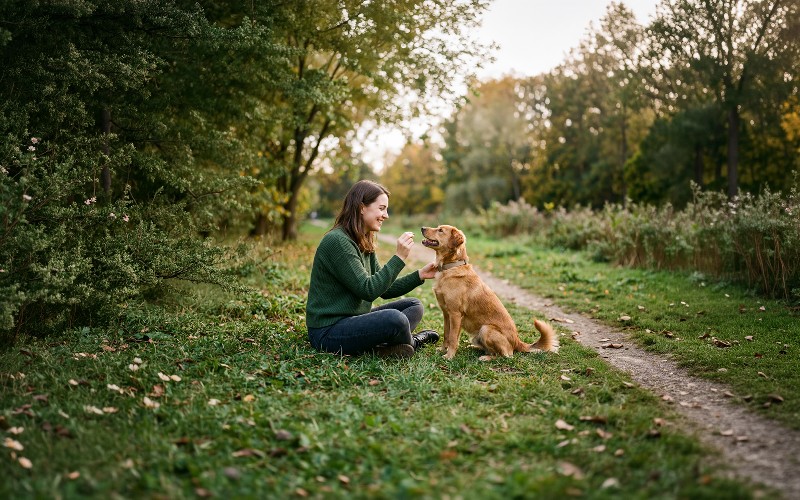
Training your dog is not about turning them into a robot. Instead, it is about giving them the skills they need to live a balanced, happy life and to build a relationship based on trust and respect with you. To start this journey, basic commands can be a great help: they teach us to cooperate with our dog, to understand them and listen to them, turning simple exercises into moments of connection and shared understanding.
Basic commands are the first shared language between you and your dog. A starting point that, while simple, helps build the foundation for a deeper communication and a more balanced everyday life. These commands are usually taught through luring, a technique where food is used to guide the dog into performing a specific action.
Choosing the Right Reward Rewards play a key role in helping your dog understand and enjoy the learning process. The best reward is something your dog finds highly motivating and is excited to work for.
Rewards play a key role in helping your dog understand and enjoy the learning process. The best reward is something your dog finds highly motivating and is excited to work for.
While some dogs can be successfully trained using their regular kibble, many respond better to soft, highly palatable treats that are quick and easy to eat. Choose rewards that are appealing to your dog without significantly affecting their daily diet. Soft treats are often a great option, as they can be consumed quickly and help maintain focus during training sessions.
To ensure proper learning, it is important to follow a clear sequence:
Verbal command
Hand gesture (visual cue)
Reinforcement (reward)
This order helps the dog gradually understand the verbal cue. Dogs naturally understand gestures more easily, since visual communication is closer to their own way of interacting.
After a nice training session, offer your dog a Farmina Dental Treat, perfect for their oral health and for relaxing!
How to Teach Your Dog Essential Skills
Sit
Execution
Take a few steps backward while encouraging the dog to follow the treat. Stop, then slowly raise your hand above the dog's head and slightly backward. As the dog follows the treat with their nose, they will naturally sit down.
When to reward
Immediately as the dog sits.
How to correct mistakes
If the dog stands up or does not sit, simply repeat the exercise. If the dog continues not to understand, it is better to pause and try again later rather than forcing the learning process.
Down
Execution
Starting from the sit position, guide the dog with an L-shaped movement. Lower the treat straight down to the ground between the dog's front paws, then slowly move it forward along the floor, away from the dog's chest. As the dog follows the treat, they will naturally lower themselves into a lying position. Make sure there is enough space in front of the dog.
When to reward
As soon as the dog lies down.
How to correct mistakes
If the dog stands up or does not go down, repeat calmly. If the dog is struggling, it is better to stop and try again at another time.
Heel (walking close to you)
Execution
Guide your dog to stay beside you, holding treats in one hand, and start walking. The goal is for the dog to remain at your side during movement.
When to reward
After a few seconds of staying beside you, reward the dog. Gradually increase the duration over time.
How to correct mistakes
If the dog gets distracted, stops, or moves ahead of you, it is part of the learning process. Gently guide them back to your side and continue. If the dog keeps wandering off, reward them as soon as they return to you. Using a leash can help at the beginning. Start in a low-distraction environment to make learning easier.
Stay
Execution
This command should be practiced both in a sit and a down position. At the beginning, keep the leash on. Stand in front of your dog, hold up a hand as a signal, and take a few steps backward. Start with very short distances and gradually increase them. Eventually, remove the leash.
When to reward
Only reward the dog when you return to them.
How to correct mistakes
Avoid using the dog’s name during this exercise, as it may be interpreted as a recall cue. If the dog gets up or comes toward you, calmly bring them back to the required position. This is a more advanced exercise that requires patience and consistency.
Recall (coming when called)
Execution
Start in a low-distraction environment. Allow your dog to move a short distance away, then call them using your chosen recall cue in a happy, inviting tone. You can encourage them by moving backward a few steps or opening your arms. As your dog comes toward you, remain positive and make returning to you rewarding. Gradually practice in more distracting environments and at greater distances.
When to reward
Reward immediately when your dog reaches you. Use high-value rewards and praise, especially during the early stages of training.
How to correct mistakes:
If your dog does not come immediately, avoid repeating the cue excessively or showing frustration. Give them time to respond and reward them when they arrive, even if they are slow. If recall is unreliable, reduce distractions, shorten the distance, and practice in easier situations before increasing difficulty again.
Important notes:
Don’t call your dog only to end playtime or leave the park. Occasionally call them, reward them generously, and then allow them to continue playing.
Never punish a dog for coming back late. Punishment can create negative associations with recall and make the dog less likely to return in the future.
A quick note: these exercises are helpful tools, but they're not a cure-all for issues like leash pulling or recall struggles. Often, what really makes the difference is making sure your dog gets enough time outdoors, with the freedom to move, sniff, and explore.
Want to learn more? Stay tuned for our upcoming articles!